Chapter Seven: Dublin October 1909
‘Shite!’
Mickey grabbed his robe from the chair and sprinted down the stairs three at a time, tearing out of the house and round the corner to Great Brunswick Street and to the north gate of the college. He was ten minutes late already, by the time he ran across the quad, up several flights of stairs and down the hall, it was twenty. Down the rows Leary was busy lecturing, and he flung himself against the wall with the other standees, hoping not to be noticed. He was absorbed in the painting he was doing of the Liberties, forgotten the morning tutorial, and now there was hell to pay. Leary had said at the beginning of term that no matter university policy anyone late or missing from his tutorials more than three times that were not in hospital would fail the course. Mickey had been late now twice, for the same reason - painting. At least his exposition was finished. It would be too bad to be late and remiss.
His luck had flown, for Leary looked up, staring directly at him, leaning on the lectern with a faintly but unmistakably contemptuous bow. There were litters from the men and girls, and several turned to stare.
‘Well, Mr. Rafferty!’ Leary said cheerfully. ‘Imagine that you should deign to grace us with your presence! I assume your tardiness is due to something wholly admirable - a dying aunt, perhaps? Is your assignment completed, sir?’
‘O aye,’ he said decisively. Then, ‘I mean, yes, sir, it is.’ An expression fleeted over the professor's hawk-like face and was gone almost before it was noticed.
‘Good. See me after tutorial.’ He pushed himself away from the lectern. ‘Now to continue,’ he paced the dais, gathering his thoughts, then returned, leaning on the lectern again. ‘The point Mallory was making in sending off his knights was not merely some great religious quest, but a commentary on the practices of his society as well. We must not see this merely as religious conquest, although I fancy the church would have us see it otherwise. Nor must we see it merely as a symbolic allegory. Mallory was an acute critic of the political powers of his day.’ Leary pushed his glasses up farther on his nose. ‘If you would be so good, Mr. Rafferty, might you tell us what practices Mallory was commenting on?’
Mickey glanced down at the text, which lay on top of the satchel at his feet. He had struggled to make literary sense, let alone political sense, of the shifting motifs and folktale character of The Death of Arthur, and was not wholly successful to this moment. He knew he was being called upon because he was late; it had happened to others. He swallowed, took a breath, and ventured,
‘A society of warriors, sir.’
There was a pause. The professor waited impatiently, then finally prompted, ‘Yes, and?’
He felt conspicuous and doomed. No one else would dare venture a comment when the question had been addressed to him. A man had tried that in the first session and been humiliated beyond repair, he had quit the course; only the girls were safe from the terror's lashing tongue. They he treated as courteously as queens. Mickey's hand came up, loosening the knot in his tie, and he saw the professor's scowl.
‘I'm afraid I don't know, sir.’
Leary gave him a look of disgust and turned away scanning the rows for other victims. In spite of incurring the man's wrath, Mickey was glad to be let off. ‘Cummings, perhaps you can enlighten us.’ He went back to the lectern, and leaned on it with his arms folded. The speckled brown worsted of his suit coat sleeve showed from under his robe, picked up the auburn colour of his hair and the amber of his hazel eyes. He looked foxy, Mickey thought, especially with that sharp nose. He would paint him as that, the fox outwitting the hunters. He turned his attention belatedly to Cummings and saw the porcine Martin scowl into his notes, searching for an answer. He found it, and looked up excitedly, saying,
‘He was criticising the custom of fiefdom, sir! Of feudalism, the owing of fealty to a lord by a vassal.’
‘Yes!’ Leary exclaimed, banging on the lectern. ‘Precisely!’ He paced again, saying, ‘As with the Crusades, it was for the very reason of feudalism that Arthur's knights went off on their quest. If you will recall previously, I stated to you that it was the duty of a vassal in return for lands and favours to fight under his lord as his army in a war or to replace the lord in battle if the lord be otherwise occupied. Thus the knights become the representatives of the King, or become Arthur, if you will, on the Grail Quest, since the King himself is bound to remain at Camelot. Ultimately it is not themselves who benefit from the glory, but the King for the sending. Their reward comes not in public accolades -- for it is only remembered that the King sent them -- but in private recompense; that is lands, moneys, titles, protection and so on. Theirs is an amorphous character in the public mind, archetypal. That is why we find so many redundant attributes given them -- brave, noble and so on, without individuation.
‘The other criticism Mallory had -- this much more dangerous to him personally -- was the matter of true kingship. He was calling Arthur, from among many other candidates, the only true king of Britain. The allegory here would not have been lost on his readers. You will recall the Wars of the Roses, so called, had recently ended and the Lancastrians --’
Mickey raised a hand.
‘Yes, sir?’
‘Sir,’ he began, picking his words carefully from among the wool of his thoughts, for the idea had come on him full-blown, ‘Why should it be so that the lord should take the laurels for not merely his own actions, but for those of men under him, when he had no part in their courage or chivalry, or what-you-will?’
Leary looked at him steadily, and the face that changed like the shadow of the sky on the land was still, thoughtful, and keen. ‘Why indeed? A good question, Mr. Rafferty,’ he said softly. He rubbed his cheek with a long bony finger. ‘In answer I can only tell you that it was the functioning of a corrupt and outmoded system that made it so, and this was in large part the reason for the exodus to the cities and the birth of trade guilds.... But it goes without saying, of course, that if the vassal failed it reflected poorly on his lord. They were in no wise independent of one another. The lord was dependent on the commodities produced by the vassal for his income and the maintenance of his lands. Now we -’
‘Mr. Leary -’
Leary looked up from his monologue to a young man in a dark blue suit.
‘Yes, Mr. Pinkerton, what is it?’ He asked irritably.
Pinkerton glanced slyly around the room. ‘Is it not the same in our own country, sir?’
Leary folded his arms. ‘How's that, Mr. Pinkerton?’ It was impossible to imagine the Lallans Scots Pinkerton speaking in favour of the Land League, Parnell, or Home Rule as a solution, which was what Leary was verging on, if Mickey was following aright. He understood, in that blinding moment, why the book had been chosen for the course, and something thereby about Patrick Leary - he was a nationalist! He should have guessed it, given what Tim had said of him, but he seemed so fitted to this place, so in league with all the great men that the prospect was bizarre at best. But he knew it. Not that there was anything to prove by it. But it was inexplicable. Trinity was the antithesis of everything the nationalists cherished. That was why Pinkerton was piping up! He knew it too, Mickey was certain.
Pinkerton's haughty glance swept the room.
‘Well sir,’ he said in drawing-room tones, ‘in the land-holding system we have here, we sometimes have the circumstance of the landlord's agent. Now, the agent is the landlord's representative, if the owner is absent. Well, sir, if the peasants,’ he paused, ever so slightly for effect, ‘should take to insurrection, it is not the agent who is held responsible, while the esteem of the landlord among his peers goes diminished for an act with which he had no connection.’
Leary had tremendous control. While Mickey ground his teeth and fidgeted at the remark, Leary did not uncross his arms, nor did his expression change. He merely said blandly,
‘Indeed, Mr. Pinkerton, you have made a fine point, worthy of discussion at any of the quayside pubs, whom I'm certain would be happy to have you. But the matter at hand is Mallory's society. To return to -’ the tolling of the eleven o'clock bell brought him up and he looked at his watch. Holding up a hand, he said, ‘Gentleman, and young ladies, we are out of time. Do please read the assigned Chaucer for discussion commencing on Wednesday. And leave your papers at the back, if you would be so good. Good day!’ He turned away from them to the blackboard where he had scrawled a complex, indecipherable outline. Mickey avoided Pinkerton and his cronies in the aisle and made his way down to the dais. Leary was filing away his lecture notes.
‘You wished to see me, sir?’
The professor glanced up from behind his glasses. ‘Ah yes, just a moment.’ He fetched the papers from the table at the back and returned with them, stuffing them into his satchel before spoke.
‘Yes.’ He leaned against the lectern and pushed up his glasses. ‘Understand me when I say this, Mr. Rafferty -’ his accent was now more pronouncedly that of his native Kerry. ‘I will not tolerate disruption in my classroom. If you cannot see to it to be on time then kindly do us the favour of not showing up. It breaks everything up. I realise this is not the country but-’
Mickey made a face.
Leary held up a hand. ‘Here now, don't look that way. I'm not saying it from snobbery like some of the old fellows in this place. I'm saying it to you because I know what it's like, coming here from the country. I was sent here by an uncle in America and I'm from Killarney. Sure, there isn't a less intellectual place in the whole of Ireland than that. Rules are different. I know country time. So you'll know what I'm saying to you about this: the Dubs, especially the lot here, are queer, and you've got to play it by their rules, see? I may seem hard on the lot of you, but I've had to be to make my way, both when a student and since I took on as a lecturer. Christ man,’ he exclaimed earnestly, ‘do you think it's any different out there in the world for an Irish man of intelligence? There are a thousand lies to combat, and we do ourselves no favours here in our own country. You may wonder why I did not take down that ass Pinkerton.’ He did not wait for ascertation of this, but went on, ‘I did not because for someone like me to rise to the bait of someone like him, only gives quarter in his mind to the notion that we are barbarians. It wastes my time, and there are more germane matters to attend to.’ His tone softened.’ Now, whatever happenstance delayed you,’ he glanced down at the paint that stained Mickey's fingernails perpetually, ‘I hope that in future literature will be considered an addition to its store, and not a detraction.’ A smile twitched about the corners of his mouth.
‘Yes, sir,’ Mickey said. ‘Thank you, sir.’
‘Good.’ Leary doffed his robe and slung it over his arm. ‘Eh, there is a way you can make this up you know.’
‘How's that, sir?’
Leary grinned. ‘You can come with us to the Abbey on Wednesday for the matinee. Robinson's The Cross Roads is on.’ He jerked his head. ‘But don't tell the Pinkertons of this world.’
Mickey smiled. ‘Very good sir.’
Leary picked up his satchel. ‘Good day to you, Mr. Rafferty. Don't forget to come to the lounge tomorrow during your hours. The food is terrible, but the company's grand.’ Before Mickey could reply, he bounded up the steps, taking them three at a time. What a strange man he was! Begod, Mickey thought. I just might go to the Abbey at that.
From that day, he was Leary's man. He not only threw himself into the course material for the three tutorials with him, but made a habit of studying related materials as well - histories, grammars, commentaries. From that day, not only was he never late, but he was careful to always have an answer; even if it was not one-hundred percent on the mark, it was making the effort that counted, he noticed. He gave over his resentment of the professor's cosseting the girls, deciding that whatever way Leary wanted to smooth the ladies' hard way was no business of his. He went to the faculty lounge hours for the first time, and found about a third of Leary's class there, listening to him and Hawkins debate the success of the Cromwellian interregnum. And he went to the Abbey on the Wednesday afternoon.
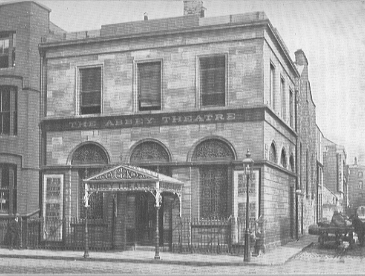
They met in the dark-green and gilt foyer adorned with murals of scenes from Irish mythology, about half a dozen students of various years, and Leary. Martin Cummings he knew, and Marjorie... he could not remember her last name. The others were upperclassmen. Leary, who was head and shoulders above the rest in an old tweed coat, caught his eye and made a welcoming gesture.
‘Michael, delighted you could make it,’ he smiled. It was all Mickey could do not to stare. Where had the terror gone? Who was this affable stranger in his place? ‘I don't believe you know everyone -’ he reeled off the names of the upperclassmen and everybody shook hands.
‘Paddy,’ said one of the men - Richard something - ‘is there time for a smoke?’ Paddy looked at his watch. ‘Just, if we hurry. Margie are you coming?’ He asked the girl.
‘Yes.’ They all went to the lounge adjacent for a cigarette, ‘Dick’ and Margie, Stuart Keating, and Paddy. Less formal indeed!
‘Close your mouth, country boy,’ Cummings grinned.
‘Not anything like Trinity, is he?’ Gerald Robbins was grinning too, his hands shoved into his pockets. He looked down at his shoes, and up again, askance, his brown hair falling across his eyes. ‘You had probably ought to know, if you hadn't guessed, he doesn't make this invitation to everyone. Consider yourself, my boy, in the inner sanctum.’ At Mickey's face of alarm, he said, ‘Oh, don't worry, it's totally inexplicable to any of us why he does it.’
‘Gobshite,’ Keating the younger exclaimed. ‘Look at your marks! The man's no fool.’ He made a comically superior face. ‘He only associates with the best of us,’ he murmured in drawing-room tones. Robbins shoved him.
‘But what's the reason?’ Mickey asked.
Keating was off-handed. ‘Because that's what was done for him.’
‘Mahaffy never took him to the Abbey,’ Robbins said, shaking his head. ‘He'd be seen in his coffin before he'd come here.’
‘You know what I mean,’ Keating insisted, ‘that it doesn't matter where you come from if you're bright. The old man himself is no swank character. He's a made man, and Paddy's just like that.’
Robbins poked him. ‘Shirrup, here they come,’ he said, and gave Mickey a warning look. He saw why Tim was so put out; he had never been asked to the Abbey, or whatever other soirees the professor got up.
The play was a tense, grim one, set in ‘a village in the West of Ireland’ - Galway by the dress. At the village crossroads a traveller - a tinker - has been found murdered. Who would kill a tinker, and why, became the question of the play. The ‘townies’, settled people, against the travellers - ‘durty tinkers’; society against outcasts; the status quo against freedom, neither side understanding the other, nor trying. It was not until the end of the play when the young curate - Rourke - stood up and cried that ‘for the love of Christ, a man has been murdered here, not an idea! Will you have no shame or pity about yourselves?’ and both sides turned against him that there was any unity. It ended there, with the whole mob crying against him. It was a ruthless commentary on humanity, those isolated in the west of Ireland especially, and a far cry from the romantic Celtic Twilight of Yeats and his bunch. Paddy leaned over and looked at Mick as the lights came up.
‘Well?’
He made a disparaging face. ‘Robinson's certainly shown up the worst of us,’ he said.
‘But accurate?’ Paddy's eyes were piercing.
‘To be sure.’
The professor nodded emphatically. ‘Just as I thought. I'm pleased to hear it from another country man, and so will Lennox be.’
‘Lennox?’
‘Robinson, you get,’ Cummings said beside him, rising.’ The playwright!’
‘And the Director,’ Paddy said, rising. ‘Come, let's say how-do to him.’ He led them up the aisle and into the foyer where a tall dark-haired slender man in a fine suit stood in a small circle of admirers. ‘Robinson!’ Paddy hailed him.
‘Ah, Leary,’ Robinson said, smiling, his accent every bit as garrison as the name implied. ‘Out with your charges again I see. You comprise most of our regular audience you know.’ His eyes twinkled briefly.
‘And happily. Robinson, among the new crop, I have a young man from Willie's country I'd like you to know - ‘ he waved Mickey forward,’ Michael Rafferty, Mr Lennox Robinson, playwright, and Director of our National Theatre.’
‘How do you do?’ Mickey said. ‘Your play was excellent. Very realistic.’
Robinson squinted at him. ‘Do you think so, by god! Well,’ he looked at Paddy, ‘that won't please Willie much. He was hoping it would fail so he could put in Diarmuid and Grainne....’ he made a bow. ‘Thank you, Mr. Rafferty, it's a high compliment from one who knows. You don't write, yourself, do you? We could use some new blood.’
Mickey flushed, glancing at the others. ‘Em, no. I paint, sir.’
‘Well, I presume you don't mean houses. Come by and see me later. I may have some work for you since John B. has fled to America.’
‘Sir?’
‘W.B.’s father,’ Paddy said. ‘The painter.’
‘Oh...Why, thank you, sir. That's very kind of you.’
‘Selfish entirely, I assure you,’ Robinson said. He looked down the foyer to the woman who was waving at him from the office. ‘Well, must dash. Thank you for coming. Good day to you all.’ And he was away, striding down the foyer on long, thin legs.
‘Leave it to the infant to make the day,’ Keating senior teased.
Paddy was smiling delightedly. ‘Everything to plan,’ he murmured, starting toward the door. Mickey hardly dared ask what that meant. He exchanged a look of dread with Cummings.
He went to Howth on the train the next fine Saturday. In wandering the city, he discovered a fascination for architecture and had used much film and paper both in jaunts around Dublin, sketching or photographing details and whole buildings. They were not necessarily posh; his painting of the Liberties was of the derelict tenements in Church Street and the people there. He had been sitting one day, sketching, on an upturned box for hours, until at last one of the brick-wall specimens of the DMP told him that unless he was an agent of the Dublin Corporation he had best get his arse back to where it belonged. He went back later with the Brownie and took photos of the building and the old wall of the city, which was uncovered when a building collapsed, near Wood Quay. It was the old wall that had reminded him he wanted to go to Howth.
He left Tara Street in the middle of the morning. After an hour of passing through the north-east of the city, through Fairview and over the mountains that ringed Dublin Bay, they came at last to Howth Head; Howth of the seaside fishermen, Howth of the hotels of the sporting wealthy, Howth of the great grey-granite castle of the Lawrences, standing in magnificent lonely splendour on the Hill of Howth. The oldest part of the castle was a Norman keep, with various additions later, mostly in the 16th century. The grounds - that is, the gardens - were open to the public for the price of 3d. The lady pirate Grace O'Malley had once cursed the family for locking their gates, hence the magnanimity. Or so said the gardener sitting beside the gate, anyway. Behind the house, on the lee side of the Bay, stretched out ten acres of gardens, dotted with fountains and as unlikely statuary as a bronze of the Duke of Wellington. The house itself was a forbidding fortress, even with the amenities of window curtains and awnings, a staunch reminder of violent times in the country. The flag above the castle flew at half-stave; the family were in but Lord Howth was not, he was told when he asked one of the gardeners. He did not enquire where Lord Howth was, as he was likely sitting in London with the others of his kind, waiting for the hunting season to begin.
The mixture of regular, genteel gardens, droves of gardeners, and fashionable window-curtains with the unyielding, battlemented stone walls and derelict old keep was weird, to say the least, as if the centuries were impinging upon each other instead of melding together, fighting for ownership of this place and pile of stone. As he stood looking at it from the seacliff, the wind whipping his hair around his eyes, Mickey was in no way certain which epoch would win. The house struck him as a sort of allegory for the gentry, struggling to win their place from the past, yet tied to it inextricably. A curious thought. He'd hardly have considered feeling sorry for the gentry before, but away from the provinciality of Sligo he saw clearly that a new order was making itself felt, based on commerce, and the old ways had no place in that order on either end - landlord or peasant. He considered this, began to walk back to the village with his hands in his pockets and his head down against the wind.
Strange to gaze on the grand pile of one's traditional ‘betters’ and think it all in jeopardy, or at least an anachronism. Life in Ireland was so slow to change. Look at Da and life at home! They were living in the Middle Ages yet, Da and Jim and the girls. Not Seanin. He looked for something else, lived for sometime else, some vague future. Mickey wondered if he knew what it was. And himself? Ha! He had taken to nineteen hundred and nine quick enough. He had not been in Dublin three months and he already took things like a bicycle, a camera, a telephone, a typewriter, electric lights, a shower-bath, trams, for granted; he had taken up smoking a pipe, not without a twinge for what a great luxury it was for his Da, he been offered jobs without asking, spent his copious free time looking at architecture and paintings, for god's sake! Here he was a farmer's son, not a few months out of the country and his family would not have recognised him. His world had grown several times over since he left little Coolaney behind.
And if he had stayed? It seemed impossible now that he could have been happy staying. If he had stubbornly stayed, what would he have become? Would he have given over drawing and painting to the grinding hard life of the farm and the docks, immolated with the rest of them? It did not please him to think of his people as immolated. It was treacherous, somehow. And yet he knew that even in this short space he had grown beyond them, could never be happy again with that small wee life. Freedom was like the salt wind blowing, bracing and clear; it had eked into his soul, and he could not go back to slavery.
Yet they kept telling him, Leary and the rest, that Dublin was provincial compared to the rest of Europe. If this was what a little bit of freedom, a little bit of money could do for him, to him, what could it do to the mass of people? A tiny breathing space and he could fly, never willing to be caged again. That was why the Lords Howth and their ilk were in trouble: soon the world would not need them anymore. Thank God, he thought, I am not to be made redundant! He was exultant, a new-created man in the garden of the great world, eager to know. There was so much he would like to know, explore ---
He turned, looking back at Howth Castle, and felt an inexplicable sadness welling, a grief for something unknown and unknowable to him. He had come here looking for the grandeur of the past, and found instead a tomb. It would all pass away, everything that they knew, he felt it, and their place in the world would be gone; then what would become of them? What happened when the world that supported you slipped away beneath your feet, like sand on the strand when the tide goes out?
He would paint it so, Howth Castle, he decided. An allegorical painting, darkness falling like a storm on the brightness of the day, a day like today. He need not come back here, there was sufficient groundwork in the photos he had taken. But he wanted to paint it here, on the wind-swept, stunning hill, looking out over the calm, Mediterranean beauty of Dublin Bay. If he could transpose Romans on the scene he would do so, failing that there was the garden pavilion that would serve. To get the view of it as well as the house, he’d have to paint it from his current vantage, which was downhill of it. No, the angle would be skewed for the Bay. Well, he’d walk it again before beginning, lay out draughting lines. He smiled at that. I have become a surveyor now! Jaysus, I don’t think this is what the O’Hara and Father Doyle had in mind at all.
He turned round again, walking. What had they in mind, sending him here? Hopes for a ‘man’ , an agent, someone of the peasantry to do their bidding with the locals? Or mere philanthropy? He didn’t know. Neither did he much care. Whyever they had sent him, he would take the road wherever it led.
On the following Thursday, he went to his regular lesson with William Orpen of the Metropolitan School of Art in Kildare Street. His tutorials at Trinity were all in the mornings on Thursdays, so he had the whole of the afternoons free. He had enrolled in the Met School for the Life Class with Orpen, who had last year been elected to the Royal Hibernian Academy, and took on a private class from him as well. He'd be putting the O'Hara's money to good use, right-o. Usually they worked for several hours, occasionally until dark, which happened more frequently as the year wore on. It was raining when they finished at five, so rather than walking home, Mickey ran round the boundary of Stephen's Green to the Municipal Art Gallery in Harcourt Street. It was pouring and he was soaked by the time that he got there, but it his favourite of the Dublin galleries, open until eight o'clock in the winter and ten in the summer to accommodate the working man, and what's more it was free.
It was the only gallery in Dublin dedicated to modern art, and he loved it not only for the works it housed - those of his teacher, Orpen, and Orpen's teacher Walter Osborne, but Courbet, Degas, Monet, Renoir and many others, including five of Rodin's immense sculptures - but for the building that housed them; Clonmel House had a fine, soaring Georgian salon with an exquisite plaster ceiling and a beautiful if leaky skylight in the central hall. It would do for now, using only half of Clonmel House, but there were many more pieces awaiting transportation to Dublin from London, excepting the public interest, which was to say, money, for the project had faltered. William Martin Murphy, the transportation and newspaper mogul, argued that the money would better be spent on new tram lines out of the city than on weird and indecent pictures. The furore had cause W. B. Yeats to write in scorn ‘things it were a pride to give are what the blind ignorant town imagines best to make it thrive...’ It was an observation not altogether unwarranted; Mickey was often only one of two or three people in the place. Even on rainy days, the light was magnificent here, and to sit and study the frescoes, listening to the ever-present Dublin rain beat down was sheer heaven. The guard at the door and the girl behind the counter knew him by name and the girl would often bring him a cup of tea as he sat or stood somewhere in the gallery, sketching.
Today he went to the third floor gallery, to look at his favourite Whistler, on loan from London, the Nocturne in Black and Gold #2. The American had been ravaged in the press for this series, ‘flinging a paint-pot in the public’s face and calling it art’, but Mickey found the sparseness of it electric. Whistler had created a masterpiece of imagery with as little distraction as possible. His paintings were not the busy things of Burne-Jones and Rosetti, but clean and uncluttered. Only essential images were allowed to remain. Mickey took a leaf from that book: in the works he conceived on his own, the form remained steadfastly minimal; he was developing a style whose use of colour was the main interest, tonal paintings and rich thematic scapes of saturated, jewel-like hues. He had discovered Gustav Klimt here too, and was over the moon. He was enthralled by that man’s use of colour and so emulated it, though it got him into trouble with Orpen.
‘You cannot experiment until you have proved your mastery of the conventional forms!’ He was told. So he submitted, at least as far as the work he did for the Met School was concerned.
After an hour it had stopped raining, and Mickey had stopped dripping. He made his unhurried way towards the door. In the hall where he retrieved his still soaking coat, he found a handbill for the Rotunda concerts. He had missed the start of this evening's fare, and Parnell Square would be too far to go in any case and still make any of the performances, but he had nothing pressing tomorrow. Time enough he heard what all the noise was about; in the faculty lounge, these concerts were touted as the last bastion of culture in the country.
He went alone as both Pete and Tim were already out. Sparing both his supper and the tram fare, he walked up the length of O'Connell Street in the fine rain, passing The Irish House, crowded this wet night; Eason's newsagents, Martin Murphy's greatest rival; Clery's grand department store where anything wanted could be had if you had the money, from a suit to the Sunday bacon; the Metropole, the Gresham, and the Imperial Hotels, in various states of splendour in the flickering yellow light of the street lamps. There were people queuing up for the picture house beyond the Parnell monument for the threepenny cinema. The working man's holiday.
The first ensemble on the programme was a string quartet, playing nice Baroque pieces by Vivaldi and Purcell. Lulling from the rain and the workday for the audience gathered, most of whom were on their way from offices. The second number was a piano soloist, playing disconcerting Russians - Tchaikowsky, Rachmaninov, and Rimsky-Korsakov. The girl could have been Slavic herself, tall and dark with high cheekbones and narrow pale eyes. But by the programme notes, she was Irish. Her Russians set his teeth on edge; all that emotive exertion was difficult to watch, harder to listen to. The third set was much better, a wind ensemble of Pucini that had the soothing quality of birdsong. But it did not put the disquiet from his mind that the grating dark music had lodged there. It gave him a headache, put him out of sorts. He'd have been better off going to the cinema.
As he was going up the aisle, he spied a familiar figure out of the corner of his eye, Paddy Leary on the far right of the room going up to the dais. He did not see him. Mickey turned at the door of the hall to watch the professor, talking intimately with the dark girl of the Russian music. They knew each other, that was sure. Paddy seemed to know plenty of girls and women. The privacy of their chat was evident in their attitudes: he bent his head, listening to what she said, a smile lighting his face, laughing softly when she was done. She took his hand in hers away from the view of the room, a lover's gesture. Mickey turned away and went out the door, but the scene remained with him.
He took the tram home and let himself in the house as it began to rain again, and went to bed although it was early. He dreamt a dark dream that night, very Gothic and punctuated by discordant Russian music, wherein he was in a country house on a dark and rainy night. Some evil pursued him, he didn't know what it was -- a dark shape, a presence, felt not seen -- but he couldn't escape it. It pursued him, moaning, mournfully. Doors opened endlessly inward, or he fell through the floor. He woke himself with a shout and sat up, shaking. He told himself it was only a stupid dream, that everything was fine. Nothing was amiss in his studio. He even lit the lamp, swearing because he burned his fingers on the match. He felt like a fool, standing there in his underwear inspecting the room. What did he hope to find? Everything was just as always -- the clothes press, the chair, the pile of unstretched canvas, the stack of stretched ones, the table with his pigments, oils, and brushes, the typewriter, piles of texts. Nothing amiss. No neighbours rowing, not even a mouse to disturb the quiet. Yet it was hours before he slept again. Lying in the pre-dawn darkness listening to the rain beat against the window, the nameless thing kept him wakeful. More than once he cursed Paddy’s dark girl and her infernal music.


0 Comments:
Post a Comment
<< Home